CLP Beacon - Business Issues and Solutions

Showing posts with label business strategy. Show all posts

Tuesday, April 4, 2017

The 7 Cornerstones of StreetSavvy℠ Leadership


The topic of leadership has come up more and more in the past month through articles in the popular press and streams on my LinkedIn page. I have commented on several articles – and even commented on the comments – because I think some of the information and concepts are either too simplistic or incorrect. For example, I read one article that relayed the one leadership skill that could change a company from good to great. It was click bait to me but I clicked …….. and commented about its incompleteness!!!!

Leadership has many facets. When you read the leadership gurus like Peter Drucker, Warren Bennis and John Maxwell, they talk about leaders having influence and followers. That is certainly true. For a more current view, I like John Maxwell’s thinking on leadership because he has a more integrative approach covering 21 indispensable qualities of the leader, and 21 irrefutable laws of leadership. He, too, touched on many components of leadership and his insights are excellent. But I don’t believe even he goes far enough.

I want to add to this thinking by talking about StreetSavvy   Leadership. This is my take, not from merely studying others and codifying what I observed, but also because I lived it and had both successes and failures as a leader. Regardless of your position in the organization, you will have both success and failure as leader. Witness the rise and fall of luminary leaders such as Jeff Immelt who took over GE and is struggling with the growth of the company. And let’s look at leaders who were successful in one company but failed to capture success in their next company … or vice versa. 

I am a NY Yankee fan and remember when the Yankees hired Joe Torre. Torre was not a good manager with the Mets, Braves and Cardinals and compiled records marginally below .500. But with the Yankees, who saw something unique, he was able to win 4 world championships and 2 additional pennants. Granted, they had great players (competencies) in that era as well but Torre was the leader and a lesser manager might not have been as successful.

StreetSavvy Leadership blends theory with reality and execution to garner results. It is leadership within the context of the company and the environment in which the company operates. Leadership without positive results in business is being a pretender. StreetSavvy Leadership means doing things differently than before to grow your business and protect against mediocrity. StreetSavvy Leadership looks at data and transforms data into knowledge and gives that knowledge to the right people closest to the decision point and trusts them to make the right decision. It means setting the right vision and ensuring alignment among all members of the exec team and throughout the organization to execute effectively and efficiently.

Here are the 7 Cornerstones to StreetSavvy Leadership:
  1. Set actionable vision. The vision has to be credible and recognized to be eventually achievable even if there is no clear path to that end. Recall when President Kennedy said: our vision is to put a man on the moon by the end of the decade. Vision is achieved by looking at the 3 Cs – customers, competitors and competencies – and ensuring that the company knows the best way to grow relative to these three components. The vision may be such that one or more of the three C’s must change over time.
  2. Keep a mindful eye on the environment and adjust. Within this construct is a concept called PEST – political, economic, social and technology changes. The leader needs to watch for changes in all of these factors and be prepared to manage responses relative to the shifts in some or all of these factors. Clearly the leader doesn’t do that on his or her own, but tasks different groups or select individuals to keep a watchful eye.
  3. Build a sustainable team.  Unless you are a one person company, leaders have to hire, train, manage, and motivate people in their organizations to achieve success. I recall one definition of leadership is to get ordinary people to extraordinary things. That is partially true. The StreetSavvy Leader understands that a strong team needs to be built and that employees want to see a solid career path. That encourages loyalty and ensures that the top employees rise to the top. However, there is a time and place to hire from the outside and not merely from the competition. If every company in the industry hired from a competitor, eventually all companies will regress to the mean, ceteris paribus. However, the StreetSavvy Leader might hire from an entirely different industry or for entirely different skills to ensure that the company doesn’t become too internally focused and can challenge its own prevailing wisdom. Training, shadowing, mentoring and other assignments make the employees well rounded. A formal program for top 10% of the execs should also be in place as both a reward and expectation of future success. IBM for many years and GE have successfully established internal programs to supplement the training of the top tier executives.
  4. Establish the right culture. Would you want to work for a leader who sets a punitive culture such that if bad news is given the leader goes ballistic? Or work for a leader who fails to recognize the success of individuals in the company yet accepts the kudos for him/herself? I worked for one boss who liked to yell at people who brought bad news to the executive meetings. I realized many years ago that I would rather meet that bad news head on and ask the executive who brought the bad news for prescriptions to manage the impact of the bad news. That reinforces the concept of responsible management and ensures that each person in the organization has the obligation to find solutions to problems.
  5. Practice open book management. People need to feel part of the organization. Ideally they should feel like part owners and have the opportunity to own a stake in the company. To do that I am a firm believer in sharing the financials and metrics that the company uses to determine success. Once these metrics and financials are shared, it would be incumbent for the executive and managers down the line to work with their people such that each person in the organization understands their role in creating revenue or managing cost. By doing this, each person can see how their job affects the success or failure of the company.
  6. Live the 5F Factors. There are five factors that characterize the StreetSavvy Leader. They are Focus, Fast Afoot, Fluidity, Flexibility, and Fast Failure. The business world shifts quickly and these five F factors enable the leader and the company to be nimble and take advantage of opportunities.
  7. Seek self-improvement. I personally have never been satisfied with who I am and what I can be. Executives have to continue to improve functional skills but also should improve in their understanding of business issues. Unfortunately, in the business world, I have seen too many CEOs and other high ranking executives believe that once they hit that lofty pinnacle, they can stop improving. Self-improvement takes place on many levels. Executives can and should continue learning by participating in peer groups, reading various business journals and biographies of successful leaders, and even self-improvement books. Having an executive coach and advisor can help as an external sounding board and someone who is not fearful telling the emperor so to speak – that he or she has no clothes. Three sixty and employee survey results which should be shared with the team can be used to help the executive understand his/her style of communications which may affect the organization’s growth. And to understand the business, what better way to do that than becoming an undercover boss or walking the production line or working as a customer service rep or front desk employee or even a bellhop or maid. I don’t believe these are radical ideas and they should be considered if you want to improve to eventually be a StreetSavvy Leader.


Jimmy Dean said: You cannot change the wind but (a leader) can always adjust his sails to reach the destination. How true. StreetSavvy Leadership reflects the Jimmy Dean quote. It is something that can be learned and if used correctly I believe it offers the best chance of success for a company. I would be glad to hear your thoughts. Feel free to comment, share and repost and let’s continue this dialog. My email is dfriedman@clevelpartners.net.

Thursday, October 13, 2016

How to Institutionalize Innovation?


I am an innovator by nature. I am always trying to do something more, to try something different, and for the companies for which I worked, to move them ahead of the competition. And I have been at the forefront of innovation thinking for quite some time through my associations with the Product Development and Management Association in the past, an angel investor with TechCoastAngels, and an Entrepreneur in Residence at UCI’s Applied Innovation.

I have been asked by clients and start-ups if a company can institutionalize innovation. The answer is simple: You bet. And you have to have a culture and management that supports innovation.

Let’s step back for a moment. First, do you know the difference between creativity and innovation? Creativity is defined as the spark generating a new idea. Innovation takes the idea to a new level and the essence of innovation is implementation through execution. Now with that out of the way, can companies figure out a way to create innovation in their company? To me the answer is clearly YES! How do you do that?
What are the categories of innovation? Here’s one list that I put together and depending on the company and their goals, there may be other categories. For innovation to take place, it should be put in the context of the company’s strategic and business plans.
  1. New products and services, ranging from line extensions, to new-to-the-company products, to new-to-the-world products.
  2. New ventures putting companies together in different ways to solve a problem.
  3. New market development such as paint companies introducing anti-bacterial paint for hospitals and children’s rooms. (Also can be classified as a new product.)
  4. New business models – for example the SaaS model replacing ownership of resources.
  5. New partnerships such as GM and Lyft or Apple and McLaren for autonomous vehicles.
  6. New business practices like Home Depot implementing Velexo’s one button installation for new technology and equipment.
There are several models that can be used to define the architecture of innovation for a company but let’s take a simplistic approach. For each of these categories, I believe we can define five different ways the categories can be analyzed and the driver of innovation can be investigated. These areas include: customer, competition, competencies, technologies, and processes.
  • Customer. Think about how you can develop new ideas. One concept is to make sure marketers and developers talk to customers on a regular basis. In Japan, engineers routinely visit customers to understand how they work with their current products and ask questions on what else is needed. Another thought for integrating customers into a company’s product development cycle is to include customers on internal development teams as we did when I was at Connexion by Boeing. Or set up a living lab where customers can play with new concepts and ideas as I believe Ford has done in the past as it designed new cars and continues to do with their new designs.
  • Competition. Looking at the competition can give insights into what is possible. Perhaps you can build off of what the competitor is doing and does it better, faster, cheaper by using new technology or developing new processes. Tools such as Spider Diagrams and SWOT analysis can provide perspective and focus.
  • Competencies. I like what Intel does and how they go about innovating. They are not afraid to make their current products obsolete and in fact, they are always thinking two steps ahead. Their competence is engineering skills. But even Intel misses the mark and has left opportunities for others in the mobile chip area such as AVAGO/Broadcom, NXPI (in the process of being acquired by Qualcomm), Skyworks and others. Companies can focus on building their competencies in various ways such as partnerships with schools/universities, labs, and even smaller, more nimble companies. An attendant benefit which we often see is that the larger company buys the smaller company because of the smaller company’s unique competencies.
  • Technologies. This, to me, is the kingpin for growth. I am probably biased as I am a technologist by training who converted to marketing and to being a business executive. Technology, above all, provides corporations the opportunity to think about the Art of the Possible. Technology can be developed internally as it used to be at Bell Labs or IBM, or can be acquired through licensing deals with universities, individuals, or start-ups.
  • Processes. Companies can look at new processes as a way to innovate. Think about ways to do self-service support for various products and services. What if a car dealer set up a few bays to enable customers to do their own repairs using their equipment and their parts? Think about Sears which has a fleet of service vans and can set a new process such that when a customer orders a washer/dryer the customer can push one button to have it installed. This is process change enabled by new technology, e.g. Velexo, which benefits both the customer and the company.
What are we missing from this model? The key requirement for innovation in a company is when senior management drives innovation and sets a standard and goal for innovation to take place. This includes the reward and recognition system that encourages innovation and makes heroes out of the innovators. Companies like 3M encourage people to spend 10% of their time developing new products. Think about the classic story of Art Fry innovating not only a product but a market based on glue that did not bond well i.e. post-it notes! Or think about how Google encourages self-directed teams to form to develop new products and services. They recognize that most of these new ideas will not be commercialized although there will be substantial winners along the way.

And let’s not forget how companies can set a metric for the number of new products that should be developed and the revenue obtained from those new products so they can sustain growth. Can anyone say Newell Rubbermaid a formidable product developing Fortune 1000 company whose brands such as Lenox, Sharpie, Sunbeam, Dymo, Oster and a slew of others?

Finally, let’s look at a few ways companies can execute their innovation program: Here are just a few ways that we have seen in the past and have participated in over the years.
  • New product advisory boards to generate new ideas on features and products.
  • New channel management advisory committees where companies can leverage their channels view of their customers and work with the channels to develop unique products and services using a common platform.
  • Appointment of a new product czar or growth leader to be the focal point for new ideas. In one of my prior assignments I formed a small organization called Ideation and Feasibility (IF) with the goal of “adopting” ideas from outside the industry to our industry.
  • Product/service roundtables that meet once every few weeks, but certainly on a recurring and regular timetable and that would include cross-functional members from technology, marketing, account management, IT, and perhaps other groups as needed. Each member will have specific roles and even track specific competitors. Think about using Dropbox or some other common storage area for posting what the competitor is doing. Better yet, how about a “war room” where the group can track what customers and competitors are doing?
  • Participation directly or through Corporate VC or business development functions in entrepreneurial activities such as the angel investment groups like TechCoastAngels and venues such as UC Irvine’s Applied Innovation where the corporation can invest in or participate in other ways in new start ups. This might be particularly true of innovations in the life sciences and cyber security areas.
In a future blog I will cover how to evaluate such opportunities in order to drive profitable revenue growth. In the meantime, if you want to discuss this topic feel free to reach me at dfriedman@clevelpartners.net.

Wednesday, August 24, 2016

How To Track Customer Acquisitions : Customer Lifecycle, Sales Funnel, and Content Strategy

Building an effective sales funnel that is able to manage and track a company's lead development and follow through is critical to any businesses' offline or online marketing success. Building that and being able to manage complex metrics and analytics makes it even more challenging. But if you can tie it to your content marketing strategy and you hit a home run! This lengthy article is one of the best written I have seen that takes the reader through the entire process.

Editor’s Note: This article was originally published by Myk Pono on The Startup, a Medium publication. The below is an excerpt from the post. You can read the full article here.


How To Track Customer Acquisitions:

Customer Lifecycle, Sales Funnel, and Content Strategy

This article will walk you through the customer acquisition funnel for SaaS companies. The primary goal is to help you design, analyze, and optimize your customer acquisition process. The secondary goal is to present different perspectives on moving customers through the lifecycle stages and to show how marketing, sales, and customer success teams should collaborate and where each team’s responsibilities lay. Hopefully, everyone will find at least one useful idea to try or to test.
The effectiveness of your customer acquisition funnel can be tracked by metrics that measure leakages when moving prospects from one stage to the other. The process of handing over prospects from the marketing to sales team and from the sales to customer success team presents higher than average risks of losing prospects, missing data, or miscommunication between teams about responsibilities, definitions, and success metrics.
Content strategy is one of the most effective ways for companies to increase the velocity with which prospects move from one stage to the other. As we go through each step in the funnel it will become clear why it is crucial to analyze content strategy from a customer lifecycle perspective. In favor of simplicity, the customer acquisition diagram is missing the reference to target customer profilesproduct positioning, and value messaging. These three topics require a separate discussion.
Other pieces that are missing in this diagram are Customer Acquisition Cost (CAC) and Customer Lifetime Value (LTV). Again, this information was omitted for the purpose of clarity.
The customer acquisition funnel is a process of tracking and monitoring how effective the company is in attracting, engaging, converting, and retaining its customers.
Part 1 — Customer Acquisition Framework
1.1. What is the difference between a customer lifecycle and a sales funnel?
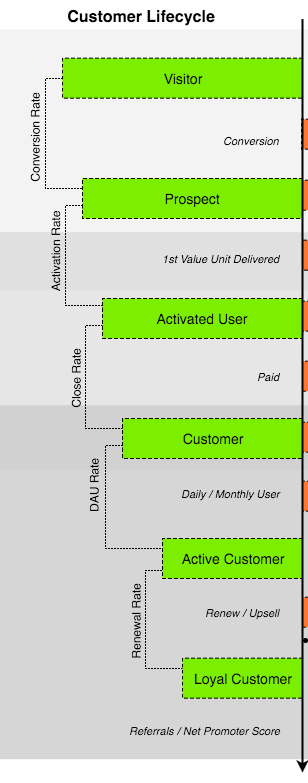
Customer Lifecycle helps companies understand how customers are experiencing your product and what actions they are taking.
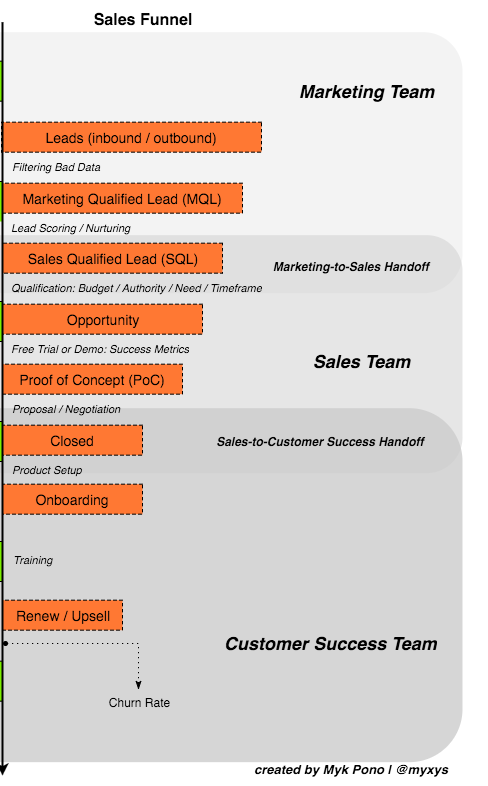
Sales Funnel shows internal processes that companies need to follow in order to move prospects down the funnel effectively and efficiently.
The diagram shows that the sales funnel is shorter than the customer lifecycle. For companies that track both, the sales funnel is just one part of the overall customer lifecycle journey.
Customer Acquisition Framework
Sales-centric approach vs. Customer-centric approach
If we only discuss the Sales Funnel part of the Customer Acquisition Framework, it’s easy to forget that customers look at your product differently and there are multiple paths to conversion.
The sales funnel is used by organizations to analyze how effectively they move prospects through the sales pipeline. Sales funnel stages represent a prospect’s current stage as the company sees it. As a prospect moves down the funnel, the probability of closing the deal increases.
For example, a company may know they have a 30% probability (based on past sales) of closing a prospect once they reach the opportunity stage. They use this probability when doing sales planning and modeling. If they currently have $500,000 in opportunities, then they have a potential for $150K in closed business.
NOTE: If you are doing sales planning, you need to take into account the average time it takes to move a prospect from the opportunity stage to the closed stage. Using the example above, if it takes an average of 60 days to close an account after it becomes an opportunity, the company can forecast a revenue of $50K net 30 and the remaining $100K net 60.
Customer lifecycle is a framework that puts the customer at the center of the process and looks at how they move along the buying process. It provides insights on customer’s actions that identify an increased probability of buying your product.
For companies that have a freemium business model, the customer lifecycle funnel is more important than the sales funnel. A great example of this is Slack, which offers their basic service for free, but converts free customers into paid customers by offering additional features. Obviously, a sales funnel with MQLs and SQLs isn’t tracked at Slack since their bottom-up approach to customer acquisition eliminates this need.
Finally, it’s important to remember that the higher the product price, the more emphasis companies should place on monitoring sales cycle. For example, Salesforce’s free trial isn’t as useful as Slack’s since their product is too complicated and needs significant resources to be integrated. Therefore, following the internal sales funnel makes more sense.

1.2. Customer Lifecycle Funnel
The Customer Lifecycle is often drawn as a circle, but in this case we use a vertical representation to make it easier to visualize the relationship between the customer lifecycle and sales funnel. There are six stages the customer has to go through in order to “complete the circle”. Each transition between stages corresponds with a direct action that customer has to do or achieve. Think of this process as different levels in a video game.
To become a visitor, somebody needs to visit your company’s website. When they submit a form or sign up for a free trial, they become a prospect. Prospects then become activated users when value is delivered or a certain level of usage is reached.
Let’s quickly go over each stage.
Customer Lifecycle
Visitor-Visitor is a very broad category that includes everyone who lands on your website. In theory, every visitor is a potential customer (not really). When a visitor signs up for a free trial or downloads something (e.g., case study, ebook, etc.), they become a prospect.
Action required to move to the next stage: Conversion
Prospect-A visitor becomes a prospect once they convert on a website. A prospect is a potential customer who has expressed interest in the pains, solutions, products, or materials related to your company. The contacts on a list that your marketing team might buy from a third party are not prospects since they haven’t actively expressed interest by sharing their information nor have they been qualified by your sales development team.
Metric: Conversion Rate
The conversion rate, in a sense, tracks the effectiveness of your website and content. Overall, the conversion rate for your website is a more generic metric (and can be ignored), but the conversion rate for free trial and product signups pages are more explicit and actionable.
Action required to move to the next stage: 1st value delivered
Activated User-Not tracking user activation during the initial signup or a free trial is one of the most common mistakes SaaS companies make. They are focused vastly on getting customers into the product that first interaction with the product becomes an afterthought. Tremendous resources are spent to get prospects in and even more resources should be allocated to designing the first experience and getting prospects to the aha-moment when first value is delivered.
The primary goal after getting a prospect inside your product is to activate them by delivering the core value unit for the first time. You entice the prospect to reach your pre-defined activation level.
As discussed in The Cost of Poor User Onboarding, Slack user activation happens when a team chat reaches 2000 messages.
Other examples of user activation goals:
  • Subscription billing: connecting your payment options or bank account can be used to activate a user.
  • Platform connecting farmers, distributors and chefs: activation can be tracked when a first order is placed.
  • Airbnb: an activated user could be a new visitor that saves their first listing.
  • Lyft (yes, I’m rooting for the underdog!): an activated user could be one who connects a credit card to the app.
You get the point.
Metric: Activation Rate
The activation rate is a ratio to track how effective the company is in delivering first value and designing the first experience with the product. Activation rate simple shows the percentage of prospects who actually activate their free trial and received a first value unit.
Action required to move to the next stage: Customer Paid
NOTE: It can be extremely challenging for a SaaS company to use a third party onboarding solution. User-onboarding is such a critical step that it’s almost impossible for someone outside of your company to design a product that perfectly meets the needs of your customers. Your product team needs to own it.
CustomerA user or prospects becomes a customer as soon as he/she pays. Your team’s next goal is make this customer an active one. Two questions you want to ask your team:
  1. Do all of our customers use our product regularly?
  2. Are they happy with how much value your solution delivers?
Metric: Daily / Weekly Active User Rate
Action required to move to the next stage: regularly use product
Active CustomerYour customers can pay for the product but not use it very often or at all. An active customer is one that regularly uses your product and therefore receives value and installs habits of using your solution on a regular basis. SaaS companies need to identify what usage correlates with high Lifetime Customer Value and a higher renewal rate.
Metric: Renewal Rate / Churn
Action required to move to the next stage: Renew / Upsell
Loyal CustomerWhen a customer renews or signs up for additional features (e.g., extra seats or API access), they become a loyal customer.
Metric: Net Promoter Score / Referrals
The customer lifecycle helps you understand how customers experience your product and company. It’s a customer-centric approach in which customer action drives the funnel.
Takeaways:
  • Each stage that a customer goes through is preceded by a specific action.
  • Effectiveness of each stage needs to be tracked and optimized with conversion metrics.
  • For products that have free trials, it’s crucial to track ‘Activated Users’. This metric is an important checkpoint for measuring intermediate steps between the ‘prospect’ and ‘customer’ stages.
  • Companies need to know how often customers use their product/solution and how much value they derive from it.
NOTES:
Buying decisions for larger companies are rarely done by one person. Because of this, the “Customer Lifecycle” refers to everyone (i.e., whole account) involved in the purchase and use of the product, not just one manager or one end user.
A company can request case studies and referrals from a customer as soon as it make sense. Make sure that the customer receives consistent value before asking for a case study or referrals. The customer should be at least an active customer.

1.3. Sales Funnel

Whereas the customer lifecycle is driven by customer actions and tracks how they experience the product and company, the ultimate goal of the sales funnel is following specific actions, processes, and workflows to track and optimize the sales process effectiveness.
Questions that your sales funnel has to answer:
  • How does your team prioritize leads?
  • How does your team nurture prospects?
  • What prospect actions correlate higher with closed deals?
  • How long does it take for your SDR team to reach out to leads that reach a qualifying lead score?
  • How long is your sales cycle?
  • What metric best represents efficiency of moving prospects from one stage to the next?
  • When and how do your teams handoff prospects in the funnel?
  • Do you have an onboarding plan?
Let’s take a closer look at the sales funnel.
Sales Funnel
Leads-Leads can enter the sales funnel from outbound and inbound channels.
Outbound leads  are leads created by Sales Development Reps (SDRs) by carefully targeting accounts that may have never heard about the company. Outbound email outreach is still one of the most effective tactics for generating outbound leads. Cold calls, direct mail, sending messaging on social media are all part of the outbound channel.
LEARN MORE: get everything you need to know to start outbound sales for your startup with Steli Efti’s ebook — “The Ultimate Startup Guide to Outbound Sales”.
Inbound leads  are leads created when prospects submit information in exchange for an asset (whitepaper, case study, etc.) or signs up for a free trial.
NOTE: In account-based selling approach where SDRs pre-qualify accounts before initiating an outreach prospects that showed interest can be assigned to Sales Qualified Lead (SQL).
Action required to move to the next stage: filtering bad data, enriching           inbound leads
Two things usually happen after lead data is entered in a company’s database whether it’s marketing automation or CRM: 1) filtering bad data; 2) enriching incoming leads with more information using 3rd party solutions. (insert your ad here — just kidding :) )
Marketing Qualified Lead (MQL)-Not every lead is created equal so it pays to have some sort of lead scoring system that correlates with the historic probability of closing a deal.
Lead nurturing campaigns help companies communicate with prospects. Educational content is a great way to nurture leads. Drip campaigns, newsletters, and webinars can help your marketing team qualify leads and understand when they are ready to discuss their specific problems with you. As soon as prospects hit a certain lead score they are moved to the Sales Qualified Leads stage.
LEARN MORE: In some cases MQL could be completely abundant. Tom Wentworth makes an interesting point about this in his article “Why I’m Killing the Marketing Qualified Lead”. My take on this subject is this: if your average deal size is large or your solution can’t be self-trialed by customers, then generating leads using marketing assets can still be effective. But if you are selling a self-serving solution like Slack, Dropbox or Google Apps, then you can drive customers directly to your product and skip lead forms. However, you still need to find a way to nurture and prioritize people coming through your product gates. Another interesting take on this topic by David Cancel and Dave Gerhardt from Drift — “Why We’re Throwing Out All Of Our Lead Forms And Making Content Free”.
Action required to move to the next stage: Lead score reaches the level needed to be moved to the SQL stage.
Sales Qualified Lead (SQL)At this stage, a sales development team conducts lead qualification. The qualification process depends on your target audience and it should provide your sales team with enough information to establish the level of pain or interest that the prospect has.
The BANT framework can be used in qualification process. The BANT stands for Budget, Authority, Need, and Timeframe.
NOTE: We need to also mention that if a company sells a complex solution or multiple people are involved in the purchasing process (decision maker, influencer, end-user), then a good qualification process will identify the goal and value points for each party involved in the buying process. Decision makers in two different companies might look to solve two different problems and your account executive will have more ammunition if the SDR can identify these differences.
Action required to move to the next stage: The SDR qualifies prospect using BANT approach.
OpportunityWhen a lead passes all the necessary qualification parameters, it becomes an opportunity. The SDR will schedule a demo between the prospect and account executive.
It’s a very useful practice to assign a dollar amount based on the projected deal size for every opportunity. Doing this will help the SDRs to be become more skilled at qualifying and targeting outbound accounts. It’s also a good idea for account executives to prioritize opportunities based on deal sizes.
The account executive gives a demo to the prospect and setups a guided free trial. Getting customers to agree on specific metrics to measure the success of a free trial can increase the probability of closing and reduce the length of the sales cycle.
Action required to move to the next stage: Completed demo or guided free trial.
Proof of Concept (PoC)The higher the deal size, the more important the proof of concept becomes in the sales process. For fully self-serving products, it’s easy to show a demo and give full access to the solution for a prospect to play with. But what if your product requires integration with third party data platforms?
Since setting up a trial period for a more complicated product requires extra resources from your team, the account executive and the prospect should agree on how success will be measured and what the potential deal size will be if the trial is deemed a success.
For technical products, a sales engineer can be brought into discussions with prospects.
Action required to move to the next stage: Negotiation and proposal delivery
ClosedThis is the funnest stage of all. The customer sends the signed proposal and pays for the first invoice. You ring the sales bells while everyone celebrates with champagne. But the real work actually begins now. The customer success team needs to train and fully onboard the customer so that everyone on their team can access your product.
Action required to move down the funnel: product setup
OnboardingThe customer success team (CST) leads the onboarding process by training customers on how to use your solution. In some cases, the solution will have different user roles and multiple levels of access which complicates the onboarding.
Some companies run weekly product training webinars for all customers. During these sessions, the CST can walk the customers through the most common user path and showcase new features and changes to your product.
Individual training with your customer’s inside team can be very effective. The onboarding process never truly ends. The top tech companies realize that a happy customer is cheaper to maintain than acquiring new ones. A top CST will schedule monthly or bi-weekly meetings to review customer’s metrics and check whether the product is fully meeting their needs.
Action required to move to the next stage: Training completed
LEARN MORE: Lincoln Murphy has a few great articles on customer successand onboarding. He is an expert on customer success.
Renew / UpsellThe effectiveness of your customer success team is measured by renewal, upselling, and churn metrics. Typically, the customer success team starts the renewal conversation about 2–3 months before the annual contract is set to expire. But as we discussed earlier, if your Customer Success team communicates regularly with your customers you probably don’t have to worry about setting up a separate meeting for this. Your CST can bring up a conversation about contract renewal on one of the touch-base calls that it has.
Churn Rate — the annual percentage rate at which customers stop subscribing to a service.
LEARN MORE: Tom Tunguz wrote an interesting post on how ServicesNow tracks churn.
The sales process should be designed in a way where each stage identifies where the prospect is in the sales cycle and has specific deliverables that must be met before advancing to the next stage. By monitoring metrics of conversion on each stage, you can focus on ways to increase your sales effectiveness while building strong customer relationships, which lead to higher renewal rates.
LEARN MORE:
This sales funnel is a simplified example. I want to remind you that this framework is not meant to be used as a cookie cutter solution. I highly recommend Jacco’s book “BLUEPRINTS For a SaaS Sales Organization” for a more detailed and in-depth analysis.
Also, we need to mention “The Sales Acceleration Formula” book by Mark Roberge as the best resource to understand HOW sales processes, goals, and workflows are changing depending on the different stages of the company.

You can read the second part of this lengthy blog post here


Saturday, June 25, 2016

Avoid the 4 Major Legal Risks for Start-ups

As a corporate executive, I tried to bond with lawyers who were business people first and foremost and not just ones trying to tell you why you cannot do something. However, over time, I learned that having a good legal mind attached to your project/business is critical for success. Why? Because a good business attorney is critical to manage the risks (and there always are risks) of the business.

If you remember the movie The Social Network, one of the original founders, Eduardo Saverin, did not pay attention to the terms of a contract he signed with Facebook’s Mark Zuckerberg. That cost him dearly although I have a hard time feeling bad for someone worth in excess of $5 Billion. It makes you think though that perhaps startups are different animals than normal businesses and perhaps the participants – the founders, employees and even the contractors – involved in a startup need to pay attention to several aspects of the business. By so doing, these participants can avoid the things that can go bump in the night.

I therefore, welcomed the opportunity to listen to Mark Skaist, co-chair of the corporate practice of Stradling Yocca Carlson & Rauth, one of the leading law firms in California, talk about the Legal Pitfalls in Entrepreneurship. And it is particularly relevant for me as a consultant to start-ups, a member of the boards of start-ups, a potential employee of a start-up, and as an angel investor with TechCoastAngels. I provide the following information as a convenience to the readers to be aware of these elements and strongly suggest that for legal advice see an attorney as they can help you avoid major issues. I took his talk and developed a simple checklist which can be used to ensure vital points are covered.

Mark laid out four areas that can create pitfalls. These areas are:
  • Capitalization/Equity
  • Taxes and financial obligations of company and executives
  • Intellectual Property
  • Employment

Checklists


Capitalization/Equity

  1. Have you documented all the equity transactions? Type? Class of stock? To Whom? Number of shares?
  2. Have you sold to accredited or non-accredited investors? Were the rounds distinguishable?
  3. For equity to the founders, have you adequately described voting rights, vesting terms?  
  4. Do you have a contract with the founders regarding performance, trade secrets, non-competes and similar items?
  5. Do you have any “bad actors” as executives whose prior issues might result in a problem for future investors?
  6. Do you have acceptable deal terms for original and successor investors, specifically issues relating to non-dilution rights (which could be a problem) so you don’t have an investor having leverage over the company?
  7. Do you have convertible notes with a valuation cap (if so, make sure it’s not too low)? When is the maturity date? Is this date after the potential raise for the next round?

Taxes and financial obligation of company and executives

  1. How is the stock that is granted to the different shareholders and the executives valued?  Will there be a tax liability based on the valuation of the company as reflected in the share price? Are they truly founders shares worth only a few cents or has a prior round, e.g. friends and family, been offered at a higher value per share which may create a financial obligation to the grantee of the stock?
  2. Is the stock to be granted restricted stock or stock options and what type of options are they?
  3. How is the company being valued? Have you or will you use a third party for valuation of the equity?

Intellectual Property

  1. Have all IP developed by the employees, founders and third parties been formally assigned to the company?
  2. Have all the graphic designs, logos, domains, visual representations, iconography been assigned correctly to the company?
  3. If the company is licensing IP, are the agreements to license been signed and reviewed by attorneys?
  4. Is there a clear definition of trade secrets so there is no misunderstanding as to what constitutes a trade secret?
  5. If an employee leaves the company, how are you protecting the company against loss of trade secrets? Are your internal procedures clear to safeguard trade secrets?
  6. Are all trademarks registered to the company? 
  7. Are all domains, logos, tag lines and other marketing items available for use and registered in the company’s name?  Do they conflict with a third party’s rights?
  8. Is the company name registered to minimize the potential for a legal battle with a larger better capitalized company?
  9. Are you using open source code? And if you are, are you co-mingling open source code with proprietary code such that the entire code tree is tainted and therefore treated as open source?
  10. If you intend to patent an invention, have you inadvertently “publicly disclosed” the invention (which could affect your ability to later patent it)?

Employment

  1. Do you include non-competes  in contracts with the executives, employees and contractors (if so, in some states this could be a problem)?
  2. Are all contractors clearly third parties and contracts in place between the company and them?
  3. Is there anything in the way you operate that could be construed as contractors are in essence employees of the company e.g. titles, office space, working hours, benefits, stock grants? Are contracts with individuals for less than one year?
  4. Do your contracts with suppliers state that the contract may be terminated for any cause with 30 days or less notice?           

   
Clearly the checklist is not complete and most likely other questions will arise for your particular case. Hopefully, though, this checklist is a good start to use in working with your co-founders and attorneys in structuring the best deal for the company. Many attorneys have special rates for promising start-ups and my suggestion is to talk with them to understand what they can do to protect your business and its Intellectual Property. Without this protection, things can go bump in the night. I know as I have been on both sides of the fence.


C-Level Partners helps small to mid-cap companies in the tech, service and manufacturing markets grow their top line and their margins. If you have any questions on growth and managing risk in a growth or start-up environment please feel free to contact me at dfriedman@clevelpartners.net or call me on 949 439-4503.