CLP Beacon - Business Issues and Solutions

Showing posts with label marketing. Show all posts

Thursday, February 8, 2018

Five Not So Easy Lessons on Growth Leadership


Most of us watched Superbowl 52 between the Eagles and the Patriots. Part of the charm of the
Superbowl and the parties we attend, relates to seeing the commercials. In fact, much time is used “rating” the commercials in terms of humor, appeal, and somewhere down the line the effectiveness of the advertising spend. As a piece of trivia, a Superbowl commercial this year costs $5 million for a 30 second ad PLUS the actual cost of designing, developing and shooting the commercial. Note that Nick Foles, the Eagles’ Quarterback and MVP, made only $1.6 million for the entire year. By the way, as a Giant’s fan I really liked the Eli/Odell Dirty Dancing commercial.

Last year, Coke eliminated the role of Chief Marketing Officer and reorganized around a new role of Chief Growth Officer (CGO) to integrate marketing with customer and commercial teams. Other consumer package goods (CPG) companies, such as Hershey and Kellogg, have also moved to a similar function with Kellogg instituting the function in mid-2015. How successful are those companies? It may be too early to tell. Kellogg’s results over the past few years have been passable and they might not be the best model to use. Their CGO was an advertising executive – albeit very smart and well regarded and their revenue the year after his appointment was DOWN.

We can argue that a title change may be necessary but it is certainly not sufficient for improving growth and making that revenue and growth profitable. The Chief Marketing Officer has significant issues in a corporate structure. I have seen many times that marketing is regarded as a function of planning more ads, designing creative billboards, winning the contest of the best Superbowl ad, and winning creative awards. This is more “fluff and stuff” vs the reality of hard marketing and on this basis alone, a change in title from marketing to growth officer seems warranted.

Let’s take a look at five (5) lessons that can be applied to what I call Growth Leadership.


1. Growth starts with the CEO. Without the CEO and his strategy, successful growth plans cannot be put into place. I keep reminding myself of the Alice in Wonderland quote: If you don’t know where you are going, any road will take you there. Companies who want to grow have to put a CEO with that objective in place and not all CEOs fit that bill.

2. The company has to have a growth mentality. While this may start with the CEO, the people he hires and the culture of the organization must be focused on growing. I know this may sound strange to some. Unfortunately, most of us have been in companies that believe growth is based only on EBITDA increasing. While that is important, EBITDA can be improved – at least in the short term – by cutting cost. I have never believed that you can shrink yourself into greatness.

3. Innovation must be a hallmark of a growth company. Without a solid business model and without good products companies will not grow. There is just too much competition and the internet and agile development around software puts many companies on an even footing. Think about companies you know. How many of them are growing? How many of them have a solid product line and product portfolio? Growing companies have solid portfolios and products in the wings – or a good acquisition strategy to acquire new products or partners that have these new products. A creative ad on the Superbowl is not sufficient. Recall the commercials you watched. Which ads pushed minor line extensions or existing product vs. new ones? I only recall two really new products: a Kia Stinger car and a new Lexus LC500. (BTW, I like both of these cars!!)

4. P=R-C. Let’s get to basics. Any officer in a company must recognize this fundamental equation and determine how they can affect the elements which create profit. Clearly, a Chief Growth Officer will be responsible for the revenue side as well as the investment which will be put to use in generating that revenue. As a correlate, growth officers must change their internal perspective of being cost centers to investment centers. They need to think about a concept called return on investment. Even good marketing officers that I have known, focus on a concept called ROMI or return on marketing investment, treating marketing as a business and not merely a creative channel. So, when we look at the Superbowl commercials, how many of these were merely “fluff and stuff” creating awareness for the company vs. a means to drive growth? Would the company be better off spending more than $5 million on alternative marketing activities that would directly drive growth? What is interesting is that small companies with lack of budget dollars focus on the bottom line and are tactically driven.


5. An integrated approach to growth can be achieved with forethought. Whether you call the executive a Chief Growth Officer, Chief Revenue Officer or Chief Marketing Officer, I believe this person is an integrative force within the company. This person, whether directly or indirectly, must be a linking pin between the outside world of the customer and the internal world of production and manufacturing. That person needs to connect and get different functions such as marketing, product, demand generation, social media, customer service, usability/user interface, and customer service to work together to a common end.
 
That person must be responsible for a) managing at least part of the investment in growth initiatives, b) managing or certainly influencing the innovation process relating to new products, line extensions, and processes to make the customer experience better, c) the overall go-to-market strategy and tactics that are broad to include all customer touchpoints. I call this Big M marketing where the company executives are aligned for a common purpose and focus on providing the best products and services to the customer.  Individual silos are eliminated and therefore a consistent brand image can be projected. And most, important, all these components need to have targets and be measured and reviewed as part of the business battle rhythm of the company.

The title of a function is important just as a brand and its meaning is important to a company. I am not a huge fan of marketing as it is implemented in many companies because in my opinion current Chief Marketing Officers have failed with regard to helping a company grow their revenues profitably. I have argued this many times before. I believe I am correct in my assessment, as the tenure of a CMO is approximately 4 years, lowest tenure in the C-suite and approximately half as long as their CEOs. But I also believe that there is an opportunity for companies to improve their top line growth and margins by following these 5 prescriptions. We, at C-Level Partners, are focused on helping small to mid-cap businesses improve their growth and margins. Write to me at dfriedman@clevelpartners.net to see how we can help your company grow.

Tuesday, August 29, 2017

The Message Map- a Cool Tool

How many times in your career did you have to make a presentation and had trouble hitting the mark?  Either your pitch was off point, did not cover the essential elements or you just rambled without having the focus you knew was needed to get your message across. Think about your having to make a presentation for funding for your pet project or presenting a strategic plan to your Board, dealing with an unruly press (of course the press is never unruly!!) or even presenting your credentials in an interview setting.

This is where message mapping can help prepare you for such presentations. I have used this template in different situations in my career and I want to send my thanks to Tripp Frohlichtstein, a media guru and founder of Media Masters, who taught me this method nearly 25 years ago and who recently passed away. It is actually a very simple architecture of building your messages using three different building blocks and is shown as follows:


Home Base:  The major point you are trying to convey and when discussions become tough the presenter goes back to the home base and restates the major point he/she is trying to get across.

Message Pillars:   The home base, major message is supported by 2 to 4 message pillars which are categories of items upon which the major message is based.

Proof Points:  These are the specific quantifiable or discrete items that support the message pillars.

Let’s take two examples. One of the examples is based on trying to sell a new idea to your board of directors.  In this case, the message map may have the following components;

Home Base:  We have a new SaaS product that is based on proprietary behavioral analytics incorporated with Artificial Intelligence that enables Fortune 2000 companies prevent cyber attacks.

Message Pillar 1:  Technology
               Proof point 1: 5 patented algorithms
               Proof point 2: Technology licensed from University of California
Message Pillar 2:  Partnerships
               Proof Point 1: Partnerhsip with IBM Watson
               Proof Point 2: Broadcom partnership for new chip
               Proof Point 3: Visualization tool provided by Palantir
Message Pillar 3:  Customers lined up for Beta
               Proof Point 1:  Fortune 10 company in aerospace agreed to test product in the US
               Prood Point 2: GSA contract in process
               Proof Point 3:  5 additional customers agreed to try before buying
Message Pillar 4: Competition
               Proof Point 1:  Cost will be 50% of existing competing products      
               Proof Point 2:  Competitive moat can be established based on patented algorithms
               Proof Point 3:  Co-branding with partner  creates distinct product set in eyes of the customer.

By visually writing these points out on a piece of paper the presenter has a great tool to use in preparation for the Board presentation. Additional data supplementing each message pillar or proof point can be developed as well.

The second example where the message map is useful is in preparation for interviews and  I have this technique to prepare them. Let’s say the person is a marketing expert looking for a new C-Level job where he doesn’t have the precise experience in the industry but has a related experience in working with recurring revenue streams. I will fill in part of the message map and perhaps the reader can think about what else needs to be filled in as proof points.

Home Base:  Marketing executive with more than 25 years experience developing recurring revenue streams in a diverse set of industries which relies on my creativity, innovation and use of third party partnerships to generate improved margins. (Note the bold elements which set up the 4 message pillars.)

Message Pillar 1: Recurring revenue streams
               Proof Point 1: Three companies where I led marketing to 4 new recurring revenue products
               Proof Point 2: Total revenue for 4 products was 200 million per year by the second year
Message Pillar 2: Creativity and Innovation
               Proof Point 1: Used Lead User research to design a platform product which was extensible                                          to 2 other market segments
               Proof Point 2:  Relied on my contacts at my alma mater to develop licensing agreement in                                           exchange for share of future revenue
Message Pillar 3: Partnerships
               Proof Point 1:  Partnership with University
               Proof Point 2:  Partnership with new sales channels including Geek Squad and CDW
Message Pillar 4: Improved Margins
               Proof Point 1:  Gross margins ranged from 40-65% on each product introduced.


While these examples are fictionalized (based on fact by the way), they illustrate the power of the message map. Clearly there are many elements of using the message map that are not covered in this blog. Yet the power of this type of tool is evident. 

If you have questions please contact me at dfriedman@clevelpartners.net and visit our site at www.clevelpartner.net for other resources and tools that can help your business grow. 

Tuesday, August 8, 2017

The Pen IS Mightier than the Computer- Sort Of!

Many people who know me realize that I collect pens- fountain pens. Some of my collection is shown on the left.  Last year I went to the LA Pen Show for the first time and it was packed around the mezzanine of a Marriott Hotel.   Today, I received an article from an investment group and the writer, Patrick Wilson, Senior Economic Analyst for Maudlin Economics (@PatrickW) wrote an interesting piece which resonated with me.  I wanted to share that.

As an angel investor with TechCoastAngels (www.techcoastangels.com) we listen to pitches to see which companies are investable for our investor group.  After each presentation we take notes and provide comments- both what we like and concerns.  I recall one time when a colleague was to take notes but he did not have a pen and paper and he had to find his computer.   (Of course, I offered him a pad and pen but he politely declined.)   When I read this article and thought back to my days in school and even the way I do stock and market analysis for investments, marketing, or just learning, it made me realize a few things.
First, as Patrick points out the newest technology isn’t always the best tool for the job nor as helpful as you think it might be. Recall the acronym KISS.   Pens are KISS at the right time and place.

Patrick wrote
For instance, recently I saw a Quartz article on cursive handwriting. Many schools that stopped teaching it now realize that was a mistake. Research shows that writing by hand actually helps your brain work better.
The reasons for taking handwriting seriously are worth considering even if you’re not a kid or a parent worried about education. Anyone can benefit from penmanship’s cognitive benefits, whether you’re taking notes at a meeting or just trying to figure out what you think.
Brain scans during the two activities also show that forming words by hand as opposed to on a keyboard leads to increased brain activity. Scientific studies of children and adults show that wielding a pen when taking notes, rather than typing, is associated with improved long-term information retention, better thought organization, and increased ability to generate ideas.
That matches my own experience. I used to see people at conferences taking notes on their computers and feel a little embarrassed to bring out my paper notepad. But having tried both, I found that handwriting is faster, and I retain the information better.
For all our whiz-bang technology, it turns out that a pen and notepad work better than the latest “notebook” computers and you never have to recharge them. (They’re also hackproof, at least for me. No one else can read my writing even if they steal my notepad.)
I liked the article on several levels.  First, find the right tool for the problem.  If a company is looking to do a marketing campaign, they might not need an Oracle system for a direct mail program but rather Get Response or even an Outlook plug in depending on their list size.   If a company has a large project to manage, should they use Microsoft Project or something like Odoo?  The answer is it all depends on circumstance, complexity, skills of the people using the tools and the like.
If you have questions on tools to be used in business, I would be glad to chat.  Or if you just want to talk about fountain pens we can do that as well.  BTW from left to right, the fountain pens are: Delta Dolce Vita Large, Visconti Cosmo, Pelican 800, ST DuPont Orpheo Palladium, and Waterman LeMans 100.   Contact me at dfriedman@clevelpartners.net or 949 4394503. 

Tuesday, April 4, 2017

The 7 Cornerstones of StreetSavvy℠ Leadership


The topic of leadership has come up more and more in the past month through articles in the popular press and streams on my LinkedIn page. I have commented on several articles – and even commented on the comments – because I think some of the information and concepts are either too simplistic or incorrect. For example, I read one article that relayed the one leadership skill that could change a company from good to great. It was click bait to me but I clicked …….. and commented about its incompleteness!!!!

Leadership has many facets. When you read the leadership gurus like Peter Drucker, Warren Bennis and John Maxwell, they talk about leaders having influence and followers. That is certainly true. For a more current view, I like John Maxwell’s thinking on leadership because he has a more integrative approach covering 21 indispensable qualities of the leader, and 21 irrefutable laws of leadership. He, too, touched on many components of leadership and his insights are excellent. But I don’t believe even he goes far enough.

I want to add to this thinking by talking about StreetSavvy℠   Leadership. This is my take, not from merely studying others and codifying what I observed, but also because I lived it and had both successes and failures as a leader. Regardless of your position in the organization, you will have both success and failure as leader. Witness the rise and fall of luminary leaders such as Jeff Immelt who took over GE and is struggling with the growth of the company. And let’s look at leaders who were successful in one company but failed to capture success in their next company … or vice versa. 

I am a NY Yankee fan and remember when the Yankees hired Joe Torre. Torre was not a good manager with the Mets, Braves and Cardinals and compiled records marginally below .500. But with the Yankees, who saw something unique, he was able to win 4 world championships and 2 additional pennants. Granted, they had great players (competencies) in that era as well but Torre was the leader and a lesser manager might not have been as successful.

StreetSavvy Leadership blends theory with reality and execution to garner results. It is leadership within the context of the company and the environment in which the company operates. Leadership without positive results in business is being a pretender. StreetSavvy Leadership means doing things differently than before to grow your business and protect against mediocrity. StreetSavvy Leadership looks at data and transforms data into knowledge and gives that knowledge to the right people closest to the decision point and trusts them to make the right decision. It means setting the right vision and ensuring alignment among all members of the exec team and throughout the organization to execute effectively and efficiently.

Here are the 7 Cornerstones to StreetSavvy Leadership:
  1. Set actionable vision. The vision has to be credible and recognized to be eventually achievable even if there is no clear path to that end. Recall when President Kennedy said: our vision is to put a man on the moon by the end of the decade. Vision is achieved by looking at the 3 Cs – customers, competitors and competencies – and ensuring that the company knows the best way to grow relative to these three components. The vision may be such that one or more of the three C’s must change over time.
  2. Keep a mindful eye on the environment and adjust. Within this construct is a concept called PEST – political, economic, social and technology changes. The leader needs to watch for changes in all of these factors and be prepared to manage responses relative to the shifts in some or all of these factors. Clearly the leader doesn’t do that on his or her own, but tasks different groups or select individuals to keep a watchful eye.
  3. Build a sustainable team.  Unless you are a one person company, leaders have to hire, train, manage, and motivate people in their organizations to achieve success. I recall one definition of leadership is to get ordinary people to extraordinary things. That is partially true. The StreetSavvy Leader understands that a strong team needs to be built and that employees want to see a solid career path. That encourages loyalty and ensures that the top employees rise to the top. However, there is a time and place to hire from the outside and not merely from the competition. If every company in the industry hired from a competitor, eventually all companies will regress to the mean, ceteris paribus. However, the StreetSavvy Leader might hire from an entirely different industry or for entirely different skills to ensure that the company doesn’t become too internally focused and can challenge its own prevailing wisdom. Training, shadowing, mentoring and other assignments make the employees well rounded. A formal program for top 10% of the execs should also be in place as both a reward and expectation of future success. IBM for many years and GE have successfully established internal programs to supplement the training of the top tier executives.
  4. Establish the right culture. Would you want to work for a leader who sets a punitive culture such that if bad news is given the leader goes ballistic? Or work for a leader who fails to recognize the success of individuals in the company yet accepts the kudos for him/herself? I worked for one boss who liked to yell at people who brought bad news to the executive meetings. I realized many years ago that I would rather meet that bad news head on and ask the executive who brought the bad news for prescriptions to manage the impact of the bad news. That reinforces the concept of responsible management and ensures that each person in the organization has the obligation to find solutions to problems.
  5. Practice open book management. People need to feel part of the organization. Ideally they should feel like part owners and have the opportunity to own a stake in the company. To do that I am a firm believer in sharing the financials and metrics that the company uses to determine success. Once these metrics and financials are shared, it would be incumbent for the executive and managers down the line to work with their people such that each person in the organization understands their role in creating revenue or managing cost. By doing this, each person can see how their job affects the success or failure of the company.
  6. Live the 5F Factors. There are five factors that characterize the StreetSavvy Leader. They are Focus, Fast Afoot, Fluidity, Flexibility, and Fast Failure. The business world shifts quickly and these five F factors enable the leader and the company to be nimble and take advantage of opportunities.
  7. Seek self-improvement. I personally have never been satisfied with who I am and what I can be. Executives have to continue to improve functional skills but also should improve in their understanding of business issues. Unfortunately, in the business world, I have seen too many CEOs and other high ranking executives believe that once they hit that lofty pinnacle, they can stop improving. Self-improvement takes place on many levels. Executives can and should continue learning by participating in peer groups, reading various business journals and biographies of successful leaders, and even self-improvement books. Having an executive coach and advisor can help as an external sounding board and someone who is not fearful telling the emperor so to speak – that he or she has no clothes. Three sixty and employee survey results which should be shared with the team can be used to help the executive understand his/her style of communications which may affect the organization’s growth. And to understand the business, what better way to do that than becoming an undercover boss or walking the production line or working as a customer service rep or front desk employee or even a bellhop or maid. I don’t believe these are radical ideas and they should be considered if you want to improve to eventually be a StreetSavvy Leader.


Jimmy Dean said: You cannot change the wind but (a leader) can always adjust his sails to reach the destination. How true. StreetSavvy Leadership reflects the Jimmy Dean quote. It is something that can be learned and if used correctly I believe it offers the best chance of success for a company. I would be glad to hear your thoughts. Feel free to comment, share and repost and let’s continue this dialog. My email is dfriedman@clevelpartners.net.

Tuesday, March 14, 2017

The 5 F Factors in StreetSavvy℠ Leadership.

I attended a roundtable discussion sponsored by Susan Howington, CEO of Power Connections, the other day. Susan holds these meetings with senior executives regularly and we discuss topics of interest. The topic we discussed revolved around whether a strong leader is not afraid to change his/her mind and under what circumstances they should be flexible in changing course. It appears that many leaders, in order to look strong, set a course of action, and don’t want to change for fear of looking weak and flighty.

There were several people in the discussion today including Peter DeAngelis (CEO, TechCoastAngels), Ron Davis (CEO and GM), John Theron (former CEO and current software consultant), Patrick Flynn (PE CEO and former aerospace exec) and Cindi Mullane (CEO and operations executive in the fashion industry.) This was an excellent complement of people.

The initial discussion centered on the need for clearly setting goals and objectives, continuity of strategy, becoming agile in one’s thinking, recognizing challenges and preparing your team to meet the uncertainty of these challenges, and keeping options open, e.g. predesigning flexibility into your decisions.

Many years ago, I coined the term StreetSavvy℠ as applied to many executive functions. When I worked for founding CEO of US Cellular Don Nelson, Don and I coined the phrase fast, fluid and flexible as we were trying to grow in the young but growing wireless market. I have used that concept over the past many years of my career. This was the start of thinking about the characteristics of what StreetSavvy Leadership is about. Additionally, I have also talked about fast failure in getting products to market. More recently I wrote a blog and did a talk on managing a business. The two words are Focus and PODFU (plan, organize, delegate and follow-up). After participating in this discussion group, I found myself seeing how all these components now come together in what I call the 5F Factors in StreetSavvy Leadership. These are the five factors I believe that can make leaders stronger and their companies grow.

1.  Focus. Business executives are constantly bombarded with many different product opportunities, decisions, strategies and the like.  If everything is a priority, nothing is a priority.  Therefore, the first characteristic for a StreetSavvy executive is to be laser focused.  Don’t try to do more than two or three major initiatives at the same time.  You have to have clear priorities because you need to have dedicated resources to be successful.  As Sun Tzu said: concentrate your resources at the competitors’ weakness at the point of attack.  This is the business correlate.

2.  Fast Afoot. Fast doesn’t mean reckless. Most executives believe they have to make a decision and do it with speed. Then once a decision is made you execute relentlessly. This is basically true. As executives we need to have information and facts upon which to base decisions. Unfortunately, in business, information and facts are never complete and there is a point at which more facts give you limited additional utility in making a decision. Because an executive never has complete information, decisions are always uncertain and it is a matter of how likely the decision will be correct and how potentially damaging uncertainty becomes.

3.  Fluid. Things change. Water conforms to the changing landscape to reach its destination. The destination or goal may still exist but there may be impediments along the way and obstacles to overcome. Fluidity means dealing with these changes, mostly tactically without changing the strategy or the end game. StreetSavvy Leaders continually scan the environment absorbing new facts and information. They figure out a way to maneuver through the changes that take place. Scanning the market through customer panels, tactics like mystery shopping or Undercover Boss, assigning people or teams to track a competitor – both direct and indirect – are critical to get new information and upon that new information to make informed decisions which might change the tactics of the strategy or to a lesser degree the strategy itself.

4.Flexible. Opportunity knocks and changes in tactics may occur. Tactics and strategies must be consistent with goals and objectives which are much longer term. Andy Grove, former Chairman and CEO of Intel wrote that only the paranoid survive. To me, paranoia in business is good in order not to be complacent. Executives have to look at opportunities as they arise and address them. Should an opportunity exist executives might need to change course. I recall working for one company which had negotiated a large contract with a supplier many years before. The technology shifted and over time that technology was neither as robust nor cost effective as a newer technology invented by an Israeli company. Our company chose to stay with the older technology and that was perhaps one reason why our company was not as successful as we could have been. It happens all the time. Culture has to be set to enable this flexibility as changes to a plan are not normally welcomed by the highest levels of leadership due to economic or political concerns.

5.  Fast Failure. Making a decision is one thing. Staying with a decision that becomes a losing one can cause irreparable harm to a company with potentially serious side effects like going out of business or having to lay off people. As one of the participants stated: bad new does not get better with age. I recall when I was at one of the Baby Bells and we were trying to grow our business by focusing on new product development. Unfortunately, one of the products on which we spent significant resources was not going to be a winner. The right decision was to terminate the project yet the project lead who worked for me did not want the stigma of failure on his shoulders. The culture was to “punish” failure. In this specific case it was a slow failure. In retrospect, the life support on this project should have been pulled years before. In this case with a little prompting, the project lead terminated the project and I gave him a reward for making the right decision. The culture had to be established for fast failure. Just think of Google and how many projects they have in the works at any one time. Or even 3M. They know that some projects will fail and executives are ok with that. Similar to stock trading you have to let your winners run and cut your losers quickly. How many of you are willing to do that?


How does the StreetSavvy Leader manage to implement these 5 F Factors? The primary need is to communicate and have an open dialog with your team and others lower in the chain of command. It is critical for the leader to walk the talk and become Pattonesque in their leadership style. Be on the front lines with your troops. Be visible and be communicative. Ask questions and listen and know that your obligation to your company is to new and even divergent information so you have the best chance of building a successful company.

Glad to have other viewpoints.

Monday, January 30, 2017

The Nifty 50 Websites and Resources for StreetSavvy Business Executives

My business partner, Brian Newton, and I were talking about resource for business executives.  Since I host a segment of a business cable TV Show called EYE on Business (Time Warner/Spectrum) and my section focuses on StreetSavvy Business (from my days growing up on the streets of New York, hence the image to the left), we decided to develop a "Nifty 50" list of those sites and resources that would be ideal for the StreetSavvy Business Executive.   StreetSavvy Business is aimed at finding solutions to complex business problems and by so doing executives are leading their companies in new thoughts, directions, and opportunities.   StreetSavvy Business is a way to prevent companies from regressing to the mean - and worse, mediocrity.

There more than 750 million URLs for websites in the US and around 200 million that are “active.” There are certain sites because of their breadth, content or unique perspective that can help entrepreneurs and executives alike in understanding the business environment, changing behaviors of different segments of the population, the economic environment, and the political environment. C-Level Partners put together a selection of sites that they have found to be useful to business leaders of all kinds.

We divided these sites into categories but clearly there is overlap among the websites. Based on the collective wisdom of C-Level Partners and its advisory group of more than 60 C-Level Executives, these are the sites that are used time after time by those queried.
Much of the information is free while there are premium services or subscription services. Even if there is a fee for premium services, signing up for the blogs or free newsletters will help the executive get and stay ahead. A word of caution: A website is only as good as the information that it provides for an intended purpose.

General Business
www.businessweek.com Originally called Businessweek and now called Bloomberg Businessweek, this magazine provides information and opinions on what is happening in the business world. It focuses on issues shaping markets, technology and politics, and provides options on developments which affect the business world.
www.ceo.com CEO.com is a resource for executives seeking out the latest in business news and leadership strategy. Our editors probe the web and handpick the most relevant content for the site that will help you become a more effective business leader.
www.cfo.com Targeting corporate financial executives this site offers information on Accounting & Tax, Banking & Capital Markets, Risk & Compliance, Strategy and Technology. Their content includes articles on current topics, white papers and links to other relevant content.
www.cio.com For this site’s content the “i” means “Information” so much of the content is related to technology topics. When visiting the site in January 2017 I noticed a piece on European privacy regulation which, having lived in London for 14 years, can be a minefield. Given the current state of flux in these regulations, a firm with activities linked to Europe would be well-served to remain compliant. Of course, there were many technology related items on this site which has extensive content.
www.forbes.com Published bi-weekly, Forbes features original articles on finance, industry, investing and marketing topics. Forbes also reports on related subjects such as technology, communications, science and law.
www.fortune.com Fortune Magazine competes with Forbes and Bloomberg Businessweek in the national business magazine category and distinguishes itself with long, in-depth feature articles.[2]  The magazine is best known for the Fortune 500, a ranking of companies by revenue that it has published annually since 1955.

Economic/Financial/Political/Technical
www.ft.com The Financial Times is the cornerstone of international business news, analysis, market data and company information. It provides perspective on global business issues and provides clarity in a complex business world. Also, as it is UK based, the points of view presented are less US-centric than many other publications in this list. 
www.money.cnn.com Purportedly the largest business website, CNN Money provides information on business, markets, technology, media, luxury, personal finance and a section on small business.
www.theeconomist.com The commentary makes it a requisite for any business professional. You need to stay up to date on all news to cultivate partnerships and understand the new realities of both the political and economic climate to be successful whether you are an entrepreneur or a corporate executive. Like the FT mentioned above, The Economist is UK-based and the point of view is less US-centric and thus useful for US executives to better understand communications with overseas partners or customers.
www.reuters.com Reuters.com brings you the latest news from around the world, covering breaking news in business, politics, entertainment, technology, video and pictures.
www.research.stlouisfed.org.  The St Louis Fed offers an outstanding range of publications and data on economic, financial and policy issues. Their FRED service is the data service and they make available an Excel Add-in that allows you to download historical data including thousands of series covering the entire world.
www.gartner.com, www.forrester.com, www.idc.com We lump all these together and you can add others as well. These sites provide market research, analysis and advisory services on a range of technology and Information Technology that is critical for the Chief Information Officer, Marketer and even other executives to understand.

Investment/New Technology
www.yahoofinance.com Yahoo Finance provides one of the most complete sites for business, finance and stock market news including quotes on stocks, options, and portfolio management.
www.investors.com One of my favorite sites with news and information that moves the markets and a complete tool for analyzing stocks and financial markets. It has a new America section which focuses on technology trends and companies that will change the economy.
www.motleyfool.com This is Dave and Tom Gardner’s site which became famous for its investment insight, and analysis of stocks. You can also find out which stocks and industries will make the most changes to our economy during the coming years.
www.marketwatch.com MarketWatch operates a financial information website that provides business news, analysis, and stock market data. It is a subsidiary of Dow Jones & Company, a property of News Corp.
www.seekingalpha.com Seeking Alpha is a crowd-sourced content service for financial markets. Articles and research cover a broad range of stocks, asset classes, ETFs and investment strategies.

Leadership/Management
www.bain.com Bain is a top management consulting firm that advises companies on strategy, marketing, organization, operations, IT and just about every aspect of business. They have a tab called Insights which is their blog that can help executives find new ideas that generate results.
www.mckinsey.com In the same vein as Bain, McKinsey and Company is a global management consulting firm that serves leading businesses, governments, non-government organizations and non-profits and helps them realize their performance goals. Their blog provides stories about people and research which might be useful to find and implement new ideas.
www.strategy-business.com Business strategy news articles for CEOs, corporate executives, and decision makers who influence international business management.  Their prime focus is to highlight the complex choices that leaders face — in strategy, marketing, operations, human capital, governance and other domains — and the impact of their decisions.
www.enpinstitute.com Executive Next Practices Institute is a research, collaboration, and thought leader forum composed of several thousand C-Level executives from Fortune 5000 companies, including those from C-Level Partners. Their focus is on first look innovations, beyond the current best practices.
www.cebglobal.com CEB (formerly known as the Corporate Executive Board) is a best practice insight company with several subspecialties in HR, IT/Operations, Marketing and other functional areas. It develops its programs in partnership with leading organizations around the globe and shares solutions to drive corporate performance and to effectively manage talent, customers and operations.
www.hbr.org Harvard Business Review is one of the cornerstone magazines for new ideas and classic advice on strategy, innovation, leadership, technology and marketing from the world’s best management and business thinkers.
www.linkedin.com Everyone should be on LinkedIn, the largest professional database. You can find people, new opportunities, and through groups engage in dialogs on trends, technology, marketing, business, economics and almost everything else. By participating in posting articles or sharing information you will also encourage others to find you and that can lead to business deals. Everyone likely knows that Microsoft bought LinkedIn in 2016.
www.edgar-online.com EDGAR Online is a leader in helping professionals uncover intelligence from financial disclosures. EDGAR Online offers distribution of company data and public filings for equities, mutual funds and other publicly traded assets. Check out the 10k filings of publicly traded companies to get a good understanding of the business climate and insight into their business strategy.
www.marshallgoldsmith.com Marshall Goldsmith is a leadership coach with some of the key corporate, public and non-profit leaders of the world. His books include What Got You Here Won’t Get Your There are insightful and offer many useful suggestions for motivating and energizing your teams. Also, his subscription service provides weekly 3- to 5-minute videos which offer useful suggestions for better handling challenging, or even very obvious, situations.

Innovation and Entrepreneurship
www.cbinsights.com This venture and start-up website contains a private company financing and angel investment database. It also provides excellent infographics on technology trends and shares eco-systems of market categories.
www.slideshare.net Authors, writers, and companies share their information through presentations, infographics, and documents. Owned by LinkedIn, you can now link your presentations to your LinkedIn account.
www.techcrunch.com. TechCrunch is a leading technology media property, dedicated obsessively to profiling startups, reviewing new Internet products, and breaking tech news. Check out its companion site, www.crunchbase.com, which provide an excellent database on innovative companies, their funding, and the people behind them.
www.ted.com TED Talks are inspiring and revealing. While the site talks about new ideas and trends, it is more than a site for entrepreneurs as it has a strong community. Information from these talks is beneficial to both entrepreneurs and successful corporate business people. Check out www.mashable.com as well, as these two are nice complements to each other.
www.fastcompany.com Fast Company provides a breath of fresh air as it inspires new innovative and creative thought leaders who are inventing the future of business. While aimed at the younger generation and start-ups, Fast Company provides good information on leadership and management that is applicable to the corporate executive as well giving them an edge in business.
http://www.eofire.com This is a platform and podcast for entrepreneurs and marketers. Founder, John Lee Dumas, interviews inspiring Entrepreneurs.
www.quora.com Leaders and entrepreneurs in the tech industry share their information and answer questions from the reader base.
www.entrepreneur.com This site provides the latest in news and advice for the startup entrepreneur. And the information is also useful for those in the corporate world who delve into innovation.
www.inc.com Find out the latest in tips, news, management, leadership and other resources for entrepreneurs from one of the most reputable magazines in the industry.

Marketing
www.chiefmarketer.com Chief Marketer serves marketing professionals at consumer and business-to-business brands, as well as their agencies, with rich, detailed information on measurable marketing strategies, tactics and techniques. Marketing executives discuss marketing and technology challenges, how to understand the relationships, and how to determine which tools are most effective, and the role of data and content.
www.hoovers.com Hoovers has one of the largest databases for use by business people, sales people, marketers and others and which provides in-depth information on more than 85 million companies. You can use this for targeted mailing lists and depending on the subscription you choose, you can get industry information and competitive information as well.
www.advertisingage.com Advertising Age has been around for a very long time and this website helps marketers understand advertising as part of the overall marketing mix. Many marketers still are behind in digital marketing knowledge and this site can help by sharing ideas on what others are doing. As part of Advertising Age, www.btobonline.com provides specific information for the B2B marketer including news, advice, trends and technology.
www.avention.com Avention is the new name for OneSource, a database of companies that marketers can use to find information on companies in their industry, competitors and even use it as a lead source for direct marketing campaigns.
www.marketingtoday.com Marketing Today is a combination marketing magazine and blog covering such topics as general marketing, digital marketing, social media, advertising and public relations.
www.marketo.com Marketo is basically a marketing automation site and a good one at that. It provides through its webinars, events and blogs a host of useful information that marketers can use to generate sales and partners.
www.hubspot.com Hubspot has a fantastic blog covering a range of sales and marketing topics, including A/B testing, content marketing and e-mail marketing.
www.econsultancy.com Econsultancy shares the latest digital marketing and ecommerce insight from a team of analysts and experts.
www.kissmetrics.com The KISSmetrics blog aims to help you track, analyze and optimize your digital marketing.

Miscellaneous/ Specialty
www.apple.com/education/itunes-u The iTunes U app gives you access to complete courses from leading universities and other schools — plus the world's largest digital catalog of free education content — right on your iPad, iPhone or iPod touch.
www.businessinsider.com This site has spent the past few years providing free articles and reports on a wide range of business, technology and policy issues. Quite recently they have begun to charge fees for many of their reports, which are, in fact, well researched. However, whether they’ll be considered value-for-money has yet to be determined.
www.instantcheckmate.com This is a relatively new yet interesting site which claims to have the ability to find out background information on most people. You can use it to verify people you want to hire or partner with.
www.lynda.com This site contains over 2,000 video courses on a wide range of topics which are led by industry recognized instructors. For an introduction to a new area of interest, or to dig deeper on a topic than you already are, this site likely has courses to meet your needs. This is available for a small registration fee and offers a 12-week free trial so you can assess whether this is right for you.
www.mashable.com Mashable is a global, multi-platform media and entertainment company with a focus on the intersection of technology and culture. Check out its YouTube channel as well.

www.wired.com Wired probably needs no explanation. Everyone is connected in some way to something or someone. The content is current, often leading edge material that typically is reliable. If you are unfamiliar with it, check it out. Likely you’ll be impressed and use it going forward.

If you are interested in becoming a StreetSavvy Business Executive, call me or Brian to find out how you can qualify for a complimentary 45 minute appraisal.   My telephone is 949 4394503 and email is dfriedman@clevelpartners.net.  Brian's email is bnewton@clevelpartners.net.  

Tuesday, January 17, 2017

6 Steps to Beat the Competition: Analysis and Discipline Pay Off


It is said that if you know your enemies and know yourself, you will not be imperiled in a hundred battles; if you do not know your enemies but do know yourself, you will win one and lose one; if you do not know your enemies nor yourself, you will be imperiled in every single battle.
                                    Sun Tzu- The Art of War

I am a believer in the Art of War, especially applied to business and marketing. When I talk to groups on business and marketing subjects I use this quote and it has guided me in the way I approach building businesses and helping companies grow. I have listened to numerous investment pitches at TechCoastAngels screenings (a real Shark Tank) and have heard too many times that the entrepreneur believes there is NO competition. There is always competition, i.e. another way to solve a problem or provide a service. Even when a company realizes that there is some semblance of competition, many executives believe they have more attributes, a better business model, and a stronger brand than reality leads them to accept.

Sadly, this problem extends way beyond the start up world. In 2008, Jim Keyes, CEO of Blockbuster said: “Neither Redbox nor Netflix are even on the radar screen in terms of competition.” While Redbox had its glory days and has now faded, Netflix continues to soar as they are able to take advantage of streaming media and they have evolved their business model. Blockbuster and its ubiquitous blue and yellow stores have faded into oblivion after ceasing operations in 2013. When I was at RCA (when it existed as a standalone company) one of the execs in the tube division beat his plan but unfortunately failed to recognize competition from semiconductors. He was fired. And let’s not forget other companies such as Digital Equipment Corporation, Wang, Motorola and Nokia in the tech field. Not only did they fail to understand the competition, their business strategies did not evolve. We are now seeing consumer companies such as Macy’s and Kohl’s which failed to recognize the competitive environment fast enough (can you say Amazon and online shopping) and are now closing many of their stores.

There is hope though, for most companies as they consider their competition, the environment and the competencies they need to put in place to execute a new business strategy. To that end, here are the six steps companies must take to gain and/or retain a competitive edge.
1. The first step to beat the competition is to recognize that there is competition! Competition comes from direct competitors, i.e. those offering the same type of product or service; indirect competitors; and even the do-it-yourselfers. Even if a competitor is small today, should technology or macroeconomic trends change, a small new company can become dominant. That is what happened to Blockbuster. Competition doesn’t have to come from the same players in the industry. Who would have thought Google and Apple, both, would be developing an autonomous car or at one time a smart phone. As we celebrate the 10th anniversary of the iPhone, there was a time when dominant companies in the market such as Nokia and Motorola did not consider Apple a threat and frankly, they did not believe companies like LG and Samsung were threats either. Both Nokia and Motorola have lost their luster.

Keep alert and be paranoid. Use user panels talk to “lead users” who are early innovators of new products, set up Google Alerts on companies that are current competitors as well as those which have the right competencies to become competitors. Your product might be better and that message needs to be conveyed to your target audience. You can recognize the competition through the use of user panels, discussions with “lead users’ and even setting up Google Alerts.

2. The second step is to know the competition. A couple of months ago, I was watching a classic war movie called Patton. Patton was reading the works and biography of Rommel, his nemesis, competition and enemy. Rommel in turn was trying to learn through books and other sources, how Patton thinks and how he would fight. It’s classic Sun Tzu! Even without teams of analysts and staff there are a few tips in understanding and knowing your competition.

Executives can become the equivalent of Undercover Boss. When I was the top marketing executive for US Cellular, I personally visited both my stores and those of my competitors. It’s easy to do even in a business to business environment. Other tools that can be used include Customer Advisory Boards, user panels, cross-functional teams that meet regularly to discuss competition and the environment. At ATX Group (now Sirius Connected Car), every other Friday morning I hosted a cross functional group of executives to discuss new technology and competition. Certain execs were tasked with following specific competitors and sharing that information in Microsoft Exchange folders for our sales, marketing and technologists to use. Other tools include Spider diagrams, focus groups and market research including subscribing to the industry analysts that cover your industry. In the tech field those industry analysts include Gartner, Forrester, IDC and Ovum among others. If a public company is a competitor, read their 10-Ks; it’s amazing how much information is available in that document.

3. The third step is to know yourself. Some of the same tools used to understand the competition can be used to understand your own company. Spider diagrams, side by side market research matrices that can highlight those attributes that are important to your customers and for which you perform well or poorly can help set your company’s strategic imperatives. I am a huge fan of developing a SWOT analysis which covers strengths, weaknesses, opportunities and threats. To do SWOT well companies should seek out key thought leaders in their company, regardless of level and even use newly recruited employees who have a different perspective because of their recent outside experience. Doing mystery shopping even in a business to business company is also relatively easy. At a telecom company in New Jersey, one of my marketing managers set up a false company called The Fred Racciopi Cement Shoe Company of Central New Jersey (obviously we set this up tongue and cheek) and became a customer of each competitor and well as our own company. It’s amazing what we learned and through those learnings we adjusted our training program, branding, positioning and marketing material.

4. The fourth step is to develop and explain the factors that make you different. Customers buy from companies that provide a unique value for their needs. If the value is significant, relevant to the customer, sustainable and credible, the company will have a differentiable advantage. This enables executives to create a “moat” around their company and its products, protecting the company from competitive incursions. The strength of your differentiation is akin to the size of the moat. Even commodities have moats. Think about salt or rice, two very basic commodities. Do you believe that Morton’s salt is better than other salt and worth a 15% price premium? Or how about Mahatma rice vs Kroger-branded rice? What about chicken? What company said: It takes a tough man to make a tender chicken?” (The answer is Purdue Chicken.)
If you can differentiate these commodities, you can differentiate any company and its products. There are several ways upon which to differentiate. Intellectual property (IP) or Patents is an obvious one. Even IP may not be sustainable or even relevant to your target market. Other ways to differentiate are based on what Adrian Slywotsky, author of Profit Zone, calls strategic control points which are defined as some type of unique advantage for a company based on competency or partner relationship. All companies can find at least one. These could include their brand, their business partners, distribution partners, unique processes, innovation, low cost of manufacture, unique customer knowledge, access to certain resources be they commodities or people and similar items. A company has to find those strategic control points that are relevant to their markets and be consistent and credible in delivering on those elements.

5. The fifth step is to develop plans: Developing and executing a plan is critical to success. A written plan should include specific elements. By target market, a goal needs to be defined, a strategy clearly enunciated, and tactics developed with specific milestones, costs, and a person responsible for delivering the tactics. Our opinion is that a plan should have one specific leader who is accountable for the entire result. Individuals who report to this leader need to be designated for each tactic and milestone. C-Level Partners also believes that these plans need not be long winded and in fact the best plans have focus and clarity and might even be codified on one or two pages at maximum. I personally am in favor of one page plans with specific deliverables. I like using a method called RACI (responsible, accountable, consultative and informed) to ensure that the right people in a company are involved in the development and execution of the plan.
6. The sixth and final step is to monitor, measure, modify.  Each plan developed in step 6 should have a complementary set of metrics to track the success of the plan. Metrics vary depending on the plan and some of the metrics can include: average revenue per sale, total sales, return on investment, market share, win/loss ratio of business, aided and unaided awareness, average order quantity, SEO, the timeliness of performing the tactic, and other operational, business or product criteria. Each month these metrics should be added to a scorecard – preferably balanced – and reviewed with the operational or executive team. If a metric is not on target, then the executive responsible for the metric has to provide a corrective action plan. If the metric is very critical to the business strategy or to the overall goals of the plan, then a separate deep dive should be performed where the elements of the plan can be discussed in detail.

As an executive it is sometimes hard to see the competitor when you are mired in the day to day operations. You can always look to outsource part of these six steps or recruit internally some of the best and brightest less tenured people in the company. Successful companies couple strategy with competitive analysis to create and maintain an advantage. When I first converted from an engineer to a marketer, I cut my teeth on competitive analysis. It was the perfect start to figure out how to gain an advantage for the new products I was developing for my customers. I was fortunate to have the opportunity to help drive the strategic vision of my company at the same time. That integration is, in my opinion, critical to a company’s success.

Once you gain a competitive advantage, you have to stay ahead of the competition. That is a subject for a future blog, yet we at C-Level Partners believe that maintaining a competitive edge means companies have to continue to innovate, with technology, with their people, and through their processes. They must maintain contact with customers and open their ears and even seek out criticism. And they must strive for not only incremental improvements but also stretch for what we call the “art of the possible.”

As a technologist and business executive, I always keep in mind the title from Andy Grove’s book, “Only the Paranoid Survive.” Yet with discipline and a plan as outlined in these six steps we believe that companies will be able to develop a competitive edge and flourish in this hyper competitive environment.  


If you have comments or would like to see if you qualify for a complementary appraisal contact me at dfriedman@clevelpartners.net or call me on 949 4394503.

Wednesday, August 24, 2016

How To Track Customer Acquisitions : Customer Lifecycle, Sales Funnel, and Content Strategy

Building an effective sales funnel that is able to manage and track a company's lead development and follow through is critical to any businesses' offline or online marketing success. Building that and being able to manage complex metrics and analytics makes it even more challenging. But if you can tie it to your content marketing strategy and you hit a home run! This lengthy article is one of the best written I have seen that takes the reader through the entire process.

Editor’s Note: This article was originally published by Myk Pono on The Startup, a Medium publication. The below is an excerpt from the post. You can read the full article here.


How To Track Customer Acquisitions:

Customer Lifecycle, Sales Funnel, and Content Strategy

This article will walk you through the customer acquisition funnel for SaaS companies. The primary goal is to help you design, analyze, and optimize your customer acquisition process. The secondary goal is to present different perspectives on moving customers through the lifecycle stages and to show how marketing, sales, and customer success teams should collaborate and where each team’s responsibilities lay. Hopefully, everyone will find at least one useful idea to try or to test.
The effectiveness of your customer acquisition funnel can be tracked by metrics that measure leakages when moving prospects from one stage to the other. The process of handing over prospects from the marketing to sales team and from the sales to customer success team presents higher than average risks of losing prospects, missing data, or miscommunication between teams about responsibilities, definitions, and success metrics.
Content strategy is one of the most effective ways for companies to increase the velocity with which prospects move from one stage to the other. As we go through each step in the funnel it will become clear why it is crucial to analyze content strategy from a customer lifecycle perspective. In favor of simplicity, the customer acquisition diagram is missing the reference to target customer profiles, product positioning, and value messaging. These three topics require a separate discussion.
Other pieces that are missing in this diagram are Customer Acquisition Cost (CAC) and Customer Lifetime Value (LTV). Again, this information was omitted for the purpose of clarity.
The customer acquisition funnel is a process of tracking and monitoring how effective the company is in attracting, engaging, converting, and retaining its customers.
Part 1 — Customer Acquisition Framework
1.1. What is the difference between a customer lifecycle and a sales funnel?
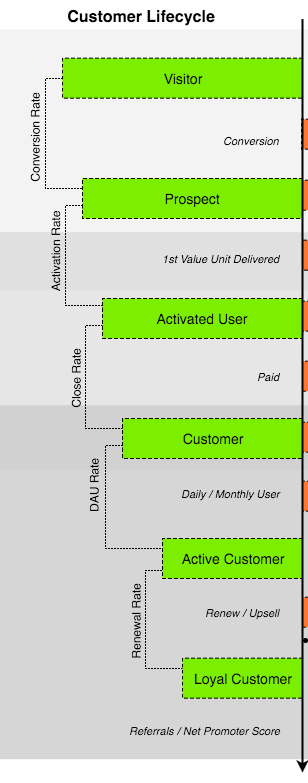
Customer Lifecycle helps companies understand how customers are experiencing your product and what actions they are taking.
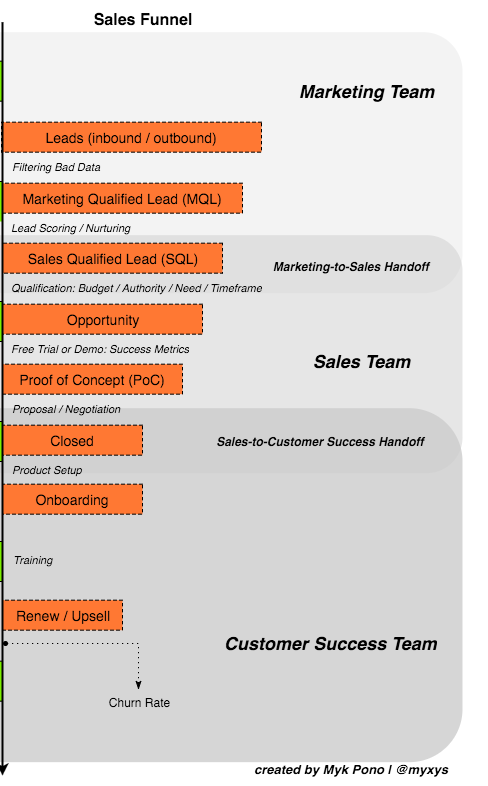
Sales Funnel shows internal processes that companies need to follow in order to move prospects down the funnel effectively and efficiently.
The diagram shows that the sales funnel is shorter than the customer lifecycle. For companies that track both, the sales funnel is just one part of the overall customer lifecycle journey.
Customer Acquisition Framework
Sales-centric approach vs. Customer-centric approach
If we only discuss the Sales Funnel part of the Customer Acquisition Framework, it’s easy to forget that customers look at your product differently and there are multiple paths to conversion.
The sales funnel is used by organizations to analyze how effectively they move prospects through the sales pipeline. Sales funnel stages represent a prospect’s current stage as the company sees it. As a prospect moves down the funnel, the probability of closing the deal increases.
For example, a company may know they have a 30% probability (based on past sales) of closing a prospect once they reach the opportunity stage. They use this probability when doing sales planning and modeling. If they currently have $500,000 in opportunities, then they have a potential for $150K in closed business.
NOTE: If you are doing sales planning, you need to take into account the average time it takes to move a prospect from the opportunity stage to the closed stage. Using the example above, if it takes an average of 60 days to close an account after it becomes an opportunity, the company can forecast a revenue of $50K net 30 and the remaining $100K net 60.
Customer lifecycle is a framework that puts the customer at the center of the process and looks at how they move along the buying process. It provides insights on customer’s actions that identify an increased probability of buying your product.
For companies that have a freemium business model, the customer lifecycle funnel is more important than the sales funnel. A great example of this is Slack, which offers their basic service for free, but converts free customers into paid customers by offering additional features. Obviously, a sales funnel with MQLs and SQLs isn’t tracked at Slack since their bottom-up approach to customer acquisition eliminates this need.
Finally, it’s important to remember that the higher the product price, the more emphasis companies should place on monitoring sales cycle. For example, Salesforce’s free trial isn’t as useful as Slack’s since their product is too complicated and needs significant resources to be integrated. Therefore, following the internal sales funnel makes more sense.

1.2. Customer Lifecycle Funnel
The Customer Lifecycle is often drawn as a circle, but in this case we use a vertical representation to make it easier to visualize the relationship between the customer lifecycle and sales funnel. There are six stages the customer has to go through in order to “complete the circle”. Each transition between stages corresponds with a direct action that customer has to do or achieve. Think of this process as different levels in a video game.
To become a visitor, somebody needs to visit your company’s website. When they submit a form or sign up for a free trial, they become a prospect. Prospects then become activated users when value is delivered or a certain level of usage is reached.
Let’s quickly go over each stage.
Customer Lifecycle
Visitor-Visitor is a very broad category that includes everyone who lands on your website. In theory, every visitor is a potential customer (not really). When a visitor signs up for a free trial or downloads something (e.g., case study, ebook, etc.), they become a prospect.
Action required to move to the next stage: Conversion
Prospect-A visitor becomes a prospect once they convert on a website. A prospect is a potential customer who has expressed interest in the pains, solutions, products, or materials related to your company. The contacts on a list that your marketing team might buy from a third party are not prospects since they haven’t actively expressed interest by sharing their information nor have they been qualified by your sales development team.
Metric: Conversion Rate
The conversion rate, in a sense, tracks the effectiveness of your website and content. Overall, the conversion rate for your website is a more generic metric (and can be ignored), but the conversion rate for free trial and product signups pages are more explicit and actionable.
Action required to move to the next stage: 1st value delivered
Activated User-Not tracking user activation during the initial signup or a free trial is one of the most common mistakes SaaS companies make. They are focused vastly on getting customers into the product that first interaction with the product becomes an afterthought. Tremendous resources are spent to get prospects in and even more resources should be allocated to designing the first experience and getting prospects to the aha-moment when first value is delivered.
The primary goal after getting a prospect inside your product is to activate them by delivering the core value unit for the first time. You entice the prospect to reach your pre-defined activation level.
As discussed in The Cost of Poor User Onboarding, Slack user activation happens when a team chat reaches 2000 messages.
Other examples of user activation goals:
  • Subscription billing: connecting your payment options or bank account can be used to activate a user.
  • Platform connecting farmers, distributors and chefs: activation can be tracked when a first order is placed.
  • Airbnb: an activated user could be a new visitor that saves their first listing.
  • Lyft (yes, I’m rooting for the underdog!): an activated user could be one who connects a credit card to the app.
You get the point.
Metric: Activation Rate
The activation rate is a ratio to track how effective the company is in delivering first value and designing the first experience with the product. Activation rate simple shows the percentage of prospects who actually activate their free trial and received a first value unit.
Action required to move to the next stage: Customer Paid
NOTE: It can be extremely challenging for a SaaS company to use a third party onboarding solution. User-onboarding is such a critical step that it’s almost impossible for someone outside of your company to design a product that perfectly meets the needs of your customers. Your product team needs to own it.
CustomerA user or prospects becomes a customer as soon as he/she pays. Your team’s next goal is make this customer an active one. Two questions you want to ask your team:
  1. Do all of our customers use our product regularly?
  2. Are they happy with how much value your solution delivers?
Metric: Daily / Weekly Active User Rate
Action required to move to the next stage: regularly use product
Active CustomerYour customers can pay for the product but not use it very often or at all. An active customer is one that regularly uses your product and therefore receives value and installs habits of using your solution on a regular basis. SaaS companies need to identify what usage correlates with high Lifetime Customer Value and a higher renewal rate.
Metric: Renewal Rate / Churn
Action required to move to the next stage: Renew / Upsell
Loyal CustomerWhen a customer renews or signs up for additional features (e.g., extra seats or API access), they become a loyal customer.
Metric: Net Promoter Score / Referrals
The customer lifecycle helps you understand how customers experience your product and company. It’s a customer-centric approach in which customer action drives the funnel.
Takeaways:
  • Each stage that a customer goes through is preceded by a specific action.
  • Effectiveness of each stage needs to be tracked and optimized with conversion metrics.
  • For products that have free trials, it’s crucial to track ‘Activated Users’. This metric is an important checkpoint for measuring intermediate steps between the ‘prospect’ and ‘customer’ stages.
  • Companies need to know how often customers use their product/solution and how much value they derive from it.
NOTES:
Buying decisions for larger companies are rarely done by one person. Because of this, the “Customer Lifecycle” refers to everyone (i.e., whole account) involved in the purchase and use of the product, not just one manager or one end user.
A company can request case studies and referrals from a customer as soon as it make sense. Make sure that the customer receives consistent value before asking for a case study or referrals. The customer should be at least an active customer.

1.3. Sales Funnel

Whereas the customer lifecycle is driven by customer actions and tracks how they experience the product and company, the ultimate goal of the sales funnel is following specific actions, processes, and workflows to track and optimize the sales process effectiveness.
Questions that your sales funnel has to answer:
  • How does your team prioritize leads?
  • How does your team nurture prospects?
  • What prospect actions correlate higher with closed deals?
  • How long does it take for your SDR team to reach out to leads that reach a qualifying lead score?
  • How long is your sales cycle?
  • What metric best represents efficiency of moving prospects from one stage to the next?
  • When and how do your teams handoff prospects in the funnel?
  • Do you have an onboarding plan?
Let’s take a closer look at the sales funnel.
Sales Funnel
Leads-Leads can enter the sales funnel from outbound and inbound channels.
Outbound leads  are leads created by Sales Development Reps (SDRs) by carefully targeting accounts that may have never heard about the company. Outbound email outreach is still one of the most effective tactics for generating outbound leads. Cold calls, direct mail, sending messaging on social media are all part of the outbound channel.
LEARN MORE: get everything you need to know to start outbound sales for your startup with Steli Efti’s ebook — “The Ultimate Startup Guide to Outbound Sales”.
Inbound leads  are leads created when prospects submit information in exchange for an asset (whitepaper, case study, etc.) or signs up for a free trial.
NOTE: In account-based selling approach where SDRs pre-qualify accounts before initiating an outreach prospects that showed interest can be assigned to Sales Qualified Lead (SQL).
Action required to move to the next stage: filtering bad data, enriching           inbound leads
Two things usually happen after lead data is entered in a company’s database whether it’s marketing automation or CRM: 1) filtering bad data; 2) enriching incoming leads with more information using 3rd party solutions. (insert your ad here — just kidding :) )
Marketing Qualified Lead (MQL)-Not every lead is created equal so it pays to have some sort of lead scoring system that correlates with the historic probability of closing a deal.
Lead nurturing campaigns help companies communicate with prospects. Educational content is a great way to nurture leads. Drip campaigns, newsletters, and webinars can help your marketing team qualify leads and understand when they are ready to discuss their specific problems with you. As soon as prospects hit a certain lead score they are moved to the Sales Qualified Leads stage.
LEARN MORE: In some cases MQL could be completely abundant. Tom Wentworth makes an interesting point about this in his article “Why I’m Killing the Marketing Qualified Lead”. My take on this subject is this: if your average deal size is large or your solution can’t be self-trialed by customers, then generating leads using marketing assets can still be effective. But if you are selling a self-serving solution like Slack, Dropbox or Google Apps, then you can drive customers directly to your product and skip lead forms. However, you still need to find a way to nurture and prioritize people coming through your product gates. Another interesting take on this topic by David Cancel and Dave Gerhardt from Drift — “Why We’re Throwing Out All Of Our Lead Forms And Making Content Free”.
Action required to move to the next stage: Lead score reaches the level needed to be moved to the SQL stage.
Sales Qualified Lead (SQL)At this stage, a sales development team conducts lead qualification. The qualification process depends on your target audience and it should provide your sales team with enough information to establish the level of pain or interest that the prospect has.
The BANT framework can be used in qualification process. The BANT stands for Budget, Authority, Need, and Timeframe.
NOTE: We need to also mention that if a company sells a complex solution or multiple people are involved in the purchasing process (decision maker, influencer, end-user), then a good qualification process will identify the goal and value points for each party involved in the buying process. Decision makers in two different companies might look to solve two different problems and your account executive will have more ammunition if the SDR can identify these differences.
Action required to move to the next stage: The SDR qualifies prospect using BANT approach.
OpportunityWhen a lead passes all the necessary qualification parameters, it becomes an opportunity. The SDR will schedule a demo between the prospect and account executive.
It’s a very useful practice to assign a dollar amount based on the projected deal size for every opportunity. Doing this will help the SDRs to be become more skilled at qualifying and targeting outbound accounts. It’s also a good idea for account executives to prioritize opportunities based on deal sizes.
The account executive gives a demo to the prospect and setups a guided free trial. Getting customers to agree on specific metrics to measure the success of a free trial can increase the probability of closing and reduce the length of the sales cycle.
Action required to move to the next stage: Completed demo or guided free trial.
Proof of Concept (PoC)The higher the deal size, the more important the proof of concept becomes in the sales process. For fully self-serving products, it’s easy to show a demo and give full access to the solution for a prospect to play with. But what if your product requires integration with third party data platforms?
Since setting up a trial period for a more complicated product requires extra resources from your team, the account executive and the prospect should agree on how success will be measured and what the potential deal size will be if the trial is deemed a success.
For technical products, a sales engineer can be brought into discussions with prospects.
Action required to move to the next stage: Negotiation and proposal delivery
ClosedThis is the funnest stage of all. The customer sends the signed proposal and pays for the first invoice. You ring the sales bells while everyone celebrates with champagne. But the real work actually begins now. The customer success team needs to train and fully onboard the customer so that everyone on their team can access your product.
Action required to move down the funnel: product setup
OnboardingThe customer success team (CST) leads the onboarding process by training customers on how to use your solution. In some cases, the solution will have different user roles and multiple levels of access which complicates the onboarding.
Some companies run weekly product training webinars for all customers. During these sessions, the CST can walk the customers through the most common user path and showcase new features and changes to your product.
Individual training with your customer’s inside team can be very effective. The onboarding process never truly ends. The top tech companies realize that a happy customer is cheaper to maintain than acquiring new ones. A top CST will schedule monthly or bi-weekly meetings to review customer’s metrics and check whether the product is fully meeting their needs.
Action required to move to the next stage: Training completed
LEARN MORE: Lincoln Murphy has a few great articles on customer successand onboarding. He is an expert on customer success.
Renew / UpsellThe effectiveness of your customer success team is measured by renewal, upselling, and churn metrics. Typically, the customer success team starts the renewal conversation about 2–3 months before the annual contract is set to expire. But as we discussed earlier, if your Customer Success team communicates regularly with your customers you probably don’t have to worry about setting up a separate meeting for this. Your CST can bring up a conversation about contract renewal on one of the touch-base calls that it has.
Churn Rate — the annual percentage rate at which customers stop subscribing to a service.
LEARN MORE: Tom Tunguz wrote an interesting post on how ServicesNow tracks churn.
The sales process should be designed in a way where each stage identifies where the prospect is in the sales cycle and has specific deliverables that must be met before advancing to the next stage. By monitoring metrics of conversion on each stage, you can focus on ways to increase your sales effectiveness while building strong customer relationships, which lead to higher renewal rates.
LEARN MORE:
This sales funnel is a simplified example. I want to remind you that this framework is not meant to be used as a cookie cutter solution. I highly recommend Jacco’s book “BLUEPRINTS For a SaaS Sales Organization” for a more detailed and in-depth analysis.
Also, we need to mention “The Sales Acceleration Formula” book by Mark Roberge as the best resource to understand HOW sales processes, goals, and workflows are changing depending on the different stages of the company.

You can read the second part of this lengthy blog post here.